Probability of 1 Girl and 3 Boys in a Family of 4 Childrens
The Boy or Girl paradox surrounds a set up of questions in probability theory, which are likewise known as The Two Kid Problem,[1] Mr. Smith's Children [2] and the Mrs. Smith Trouble. The initial formulation of the question dates back to at least 1959, when Martin Gardner featured it in his October 1959 "Mathematical Games cavalcade" in Scientific American. He titled it The Two Children Problem, and phrased the paradox as follows:
- Mr. Jones has two children. The older child is a girl. What is the probability that both children are girls?
- Mr. Smith has two children. At least ane of them is a male child. What is the probability that both children are boys?
Gardner initially gave the answers one / ii and 1 / iii , respectively, only later acknowledged that the second question was ambiguous.[one] Its answer could be 1 / 2 , depending on the process by which the information "at least 1 of them is a male child" was obtained. The ambiguity, depending on the verbal wording and possible assumptions, was confirmed by Maya Bar-Hillel and Ruma Falk,[three] and Raymond South. Nickerson.[4]
Other variants of this question, with varying degrees of ambiguity, have been popularized by Ask Marilyn in Parade Magazine,[five] John Tierney of The New York Times,[6] and Leonard Mlodinow in The Drunkard's Walk.[7] One scientific written report showed that when identical data was conveyed, but with dissimilar partially cryptic wordings that emphasized unlike points, that the percentage of MBA students who answered ane / 2 changed from 85% to 39%.[2]
The paradox has stimulated a smashing deal of controversy.[iv] The paradox stems from whether the problem setup is like for the two questions.[2] [seven] The intuitive answer is 1 / 2 .[2] This answer is intuitive if the question leads the reader to believe that there are two equally likely possibilities for the sex of the 2d child (i.due east., boy and girl),[2] [8] and that the probability of these outcomes is absolute, non conditional.[9]
Common assumptions [edit]
The two possible answers share a number of assumptions. Get-go, it is assumed that the space of all possible events can be easily enumerated, providing an extensional definition of outcomes: {BB, BG, GB, GG}.[ten] This annotation indicates that there are four possible combinations of children, labeling boys B and girls Grand, and using the kickoff letter to correspond the older child. Second, it is assumed that these outcomes are equally probable.[10] This implies the post-obit model, a Bernoulli process with p = i / ii :
- Each child is either male or female.
- Each kid has the same chance of being male person as of being female.
- The sex of each child is independent of the sexual practice of the other.
The mathematical event would be the aforementioned if it were phrased in terms of a money toss.
First question [edit]
- Mr. Jones has two children. The older kid is a daughter. What is the probability that both children are girls?
Nether the same assumptions, in this problem, a random family is selected. In this sample space, there are iv equally probable events:
-
Older kid Younger kid Girl Daughter Daughter Male child Male childGirlBoyBoy
But two of these possible events meet the criteria specified in the question (i.east., GG, GB). Since both of the two possibilities in the new sample infinite {GG, GB} are equally likely, and simply i of the ii, GG, includes 2 girls, the probability that the younger child is as well a girl is 1 / two .
Second question [edit]
- Mr. Smith has 2 children. At least one of them is a boy. What is the probability that both children are boys?
This question is identical to question one, except that instead of specifying that the older kid is a boy, it is specified that at to the lowest degree one of them is a male child. In response to reader criticism of the question posed in 1959, Gardner said that no answer is possible without data that was not provided. Specifically, that two different procedures for determining that "at least ane is a boy" could lead to the exact same wording of the problem. But they lead to different correct answers:
- From all families with two children, at least one of whom is a boy, a family is chosen at random. This would yield the answer of ane / iii .
- From all families with two children, one kid is selected at random, and the sex of that kid is specified to be a boy. This would yield an answer of i / 2 .[3] [four]
Grinstead and Snell argue that the question is cryptic in much the same way Gardner did.[eleven] They leave it to the reader to decide whether the procedure, that yields ane/iii as the answer, is reasonable for the problem as stated higher up. The formulation of the question they were considering specifically is the following:
- Consider a family with two children. Given that one of the children is a boy, what is the probability that both children are boys?
In this conception the ambiguity is virtually obviously present, considering it is non clear whether we are allowed to assume that a specific child is a boy, leaving the other child uncertain, or whether information technology should exist interpreted in the same way every bit 'at least i boy'. This ambiguity leaves multiple possibilities that are not equivalent and leaves the necessity to brand assumptions most 'how the information was obtained', equally Bar-Hillel and Falk argue, where different assumptions can lead to unlike outcomes (considering the problem statement was not well plenty defined to allow a single straightforward interpretation and answer).
For example, say an observer sees Mr. Smith on a walk with just one of his children. If he has two boys then that child must be a boy. But if he has a boy and a girl, that child could have been a girl. So seeing him with a boy eliminates not only the combinations where he has ii girls, only likewise the combinations where he has a son and a daughter and chooses the daughter to walk with.
And so, while it is certainly truthful that every possible Mr. Smith has at least 1 boy (i.e., the condition is necessary), it cannot be assumed that every Mr. Smith with at least one boy is intended. That is, the problem statement does not say that having a boy is a sufficient condition for Mr. Smith to exist identified as having a male child this fashion.
Commenting on Gardner's version of the problem, Bar-Hillel and Falk[3] note that "Mr. Smith, unlike the reader, is presumably aware of the sexual activity of both of his children when making this statement", i.due east. that 'I accept two children and at least one of them is a male child.' It must be further assumed that Mr. Smith would ever report this fact if it were true, and either remain silent or say he has at least i daughter, for the correct reply to be 1 / 3 as Gardner apparently originally intended. Simply under that assumption, if he remains silent or says he has a daughter, there is a 100% probability he has ii daughters.
Assay of the ambiguity [edit]
If it is assumed that this information was obtained past looking at both children to see if in that location is at least one boy, the condition is both necessary and sufficient. Three of the 4 every bit probable events for a two-kid family in the sample space above meet the condition, as in this table:
-
Older child Younger child DaughterDaughterGirl Boy Boy Daughter Boy Boy
Thus, if it is assumed that both children were considered while looking for a boy, the answer to question 2 is 1 / 3 . However, if the family was first selected and then a random, true statement was fabricated about the sex of one child in that family, whether or not both were considered, the right way to calculate the conditional probability is not to count all of the cases that include a child with that sex. Instead, ane must consider only the probabilities where the argument volition be made in each instance.[11] So, if ALOB represents the event where the statement is "at to the lowest degree one boy", and ALOG represents the event where the statement is "at least i girl", then this table describes the sample infinite:
-
Older child Younger kid P(this family) P(ALOB given this family) P(ALOG given this family) P(ALOB and this family) P(ALOG and this family) Daughter Girl one / iv 0 1 0 1 / four Daughter Boy 1 / iv i / 2 1 / 2 1 / 8 1 / 8 Boy Girl ane / 4 1 / two ane / two 1 / 8 1 / 8 Boy Boy ane / iv 1 0 1 / 4 0
And then, if at least one is a male child when the fact is chosen randomly, the probability that both are boys is

The paradox occurs when it is non known how the statement "at to the lowest degree one is a boy" was generated. Either respond could be correct, based on what is assumed.[12]
All the same, the " 1 / 3 " answer is obtained but by assuming P(ALOB|BG) = P(ALOB|GB) =one, which implies P(ALOG|BG) = P(ALOG|GB) = 0, that is, the other child's sexual practice is never mentioned although information technology is present. Equally Marks and Smith say, "This extreme assumption is never included in the presentation of the two-kid problem, however, and is surely not what people have in mind when they present it."[12]
Modelling the generative process [edit]
Some other way to analyse the ambivalence (for question 2) is by making explicit the generative process (all draws are contained).
Bayesian assay [edit]
Following classical probability arguments, we consider a large urn containing two children. We assume equal probability that either is a boy or a girl. The iii discernible cases are thus: i. both are girls (GG) — with probability P(GG) = 1 / 4 , 2. both are boys (BB) — with probability of P(BB) = ane / iv , and 3. one of each (G·B) — with probability of P(M·B) = i / ii . These are the prior probabilities.
Now nosotros add the boosted supposition that "at least one is a boy" = B. Using Bayes' Theorem, we observe

where P(A|B) means "probability of A given B". P(B|BB) = probability of at least one male child given both are boys = ane. P(BB) = probability of both boys = 1 / 4 from the prior distribution. P(B) = probability of at least ane being a boy, which includes cases BB and Yard·B = 1 / 4 + one / two = iii / four .
Notation that, although the natural supposition seems to be a probability of 1 / two , so the derived value of ane / 3 seems depression, the actual "normal" value for P(BB) is ane / 4 , then the 1 / 3 is actually a bit higher.
The paradox arises because the second assumption is somewhat artificial, and when describing the problem in an actual setting things go a scrap sticky. Just how do we know that "at least" one is a male child? Ane description of the problem states that we wait into a window, see only one kid and it is a boy. This sounds like the same supposition. Nevertheless, this 1 is equivalent to "sampling" the distribution (i.e. removing i child from the urn, ascertaining that it is a male child, then replacing). Let'due south phone call the statement "the sample is a boy" proposition "b". Now we take:

The difference here is the P(b), which is just the probability of cartoon a male child from all possible cases (i.e. without the "at least"), which is conspicuously ane / 2 .
The Bayesian analysis generalizes easily to the case in which nosotros relax the fifty:50 population assumption. If nosotros take no information nearly the populations then we assume a "flat prior", i.e. P(GG) = P(BB) = P(G·B) = 1 / iii . In this case the "at least" supposition produces the event P(BB|B) = 1 / 2 , and the sampling supposition produces P(BB|b) = ii / iii , a upshot also derivable from the Rule of Succession.
Martingale analysis [edit]
Suppose i had wagered that Mr. Smith had ii boys, and received fair odds. 1 pays $1 and they volition receive $4 if he has ii boys. Their wager will increase in value equally good news arrives. What bear witness would make them happier nearly their investment? Learning that at least ane child out of ii is a boy, or learning that at least one child out of one is a male child?
The latter is a priori less likely, and therefore better news. That is why the two answers cannot exist the same.
Now for the numbers. If we bet on one kid and win, the value of their investment has doubled. Information technology must double over again to get to $4, so the odds are 1 in 2.
On the other hand if i were acquire that at least one of 2 children is a male child, the investment increases as if they had wagered on this question. Our $1 is now worth $1+ 1 / iii . To get to $4 we still accept to increase our wealth threefold. So the answer is i in 3.
Variants of the question [edit]
Following the popularization of the paradox past Gardner information technology has been presented and discussed in various forms. The first variant presented by Bar-Hillel & Falk[3] is worded as follows:
- Mr. Smith is the father of two. We meet him walking along the street with a immature male child whom he proudly introduces as his son. What is the probability that Mr. Smith's other child is also a boy?
Bar-Hillel & Falk use this variant to highlight the importance of because the underlying assumptions. The intuitive reply is 1 / 2 and, when making the almost natural assumptions, this is right. However, someone may argue that "…earlier Mr. Smith identifies the male child every bit his son, we know simply that he is either the begetter of two boys, BB, or of two girls, GG, or of one of each in either birth club, i.east., BG or GB. Assuming over again independence and equiprobability, we brainstorm with a probability of 1 / 4 that Smith is the father of ii boys. Discovering that he has at to the lowest degree 1 boy rules out the event GG. Since the remaining three events were equiprobable, we obtain a probability of ane / 3 for BB."[iii]
The natural supposition is that Mr. Smith selected the child companion at random. If so, as combination BB has twice the probability of either BG or GB of having resulted in the male child walking companion (and combination GG has zero probability, ruling it out), the union of events BG and GB becomes equiprobable with event BB, and so the chance that the other child is also a boy is ane / ii . Bar-Hillel & Falk, however, suggest an alternative scenario. They imagine a culture in which boys are invariably chosen over girls as walking companions. In this case, the combinations of BB, BG and GB are assumed every bit likely to have resulted in the male child walking companion, and thus the probability that the other child is also a boy is one / 3 .
In 1991, Marilyn vos Savant responded to a reader who asked her to respond a variant of the Boy or Daughter paradox that included beagles.[5] In 1996, she published the question again in a different course. The 1991 and 1996 questions, respectively were phrased:
- A shopkeeper says she has 2 new baby beagles to show you lot, but she doesn't know whether they're male, female, or a pair. You tell her that you want only a male, and she telephones the fellow who's giving them a bath. "Is at least one a male?" she asks him. "Yeah!" she informs you with a grin. What is the probability that the other i is a male?
- Say that a woman and a man (who are unrelated) each accept two children. We know that at least one of the woman'south children is a boy and that the man's oldest child is a male child. Tin you explain why the chances that the adult female has two boys do non equal the chances that the human has two boys?
With regard to the second formulation Vos Savant gave the classic respond that the chances that the woman has two boys are about 1 / 3 whereas the chances that the human has two boys are about 1 / two . In response to reader response that questioned her analysis vos Savant conducted a survey of readers with exactly ii children, at to the lowest degree ane of which is a boy. Of 17,946 responses, 35.ix% reported two boys.[ten]
Vos Savant's articles were discussed past Carlton and Stansfield[10] in a 2005 commodity in The American Statistician. The authors do not discuss the possible ambiguity in the question and conclude that her answer is correct from a mathematical perspective, given the assumptions that the likelihood of a child being a boy or daughter is equal, and that the sex activity of the second child is independent of the starting time. With regard to her survey they say it "at least validates vos Savant's right assertion that the "chances" posed in the original question, though like-sounding, are different, and that the first probability is certainly nearer to 1 in three than to one in 2."
Carlton and Stansfield go along to discuss the common assumptions in the Boy or Girl paradox. They demonstrate that in reality male children are actually more likely than female children, and that the sexual practice of the second child is not independent of the sex of the first. The authors conclude that, although the assumptions of the question run counter to observations, the paradox still has pedagogical value, since it "illustrates one of the more intriguing applications of conditional probability."[x] Of course, the actual probability values do not thing; the purpose of the paradox is to demonstrate seemingly contradictory logic, not bodily birth rates.
Information near the kid [edit]
Suppose we were told non only that Mr. Smith has two children, and i of them is a male child, simply besides that the boy was built-in on a Tuesday: does this modify the previous analyses? Once more, the answer depends on how this data was presented - what kind of selection process produced this knowledge.
Post-obit the tradition of the problem, suppose that in the population of two-kid families, the sex of the two children is independent of ane another, equally likely boy or girl, and that the birth appointment of each child is independent of the other child. The chance of beingness born on any given day of the week is 1 / seven .
From Bayes' Theorem that the probability of two boys, given that ane male child was born on a Tuesday is given by:

Assume that the probability of being born on a Tuesday is ε = ane / vii which volition be set after arriving at the general solution. The second gene in the numerator is simply one / 4 , the probability of having two boys. The beginning term in the numerator is the probability of at least one male child built-in on Tuesday, given that the family unit has two boys, or ane − (1 − ε)2 (one minus the probability that neither boy is born on Tuesday). For the denominator, let united states of america decompose: . Each term is weighted with probability one / iv . The starting time term is already known past the previous remark, the concluding term is 0 (in that location are no boys). and is ε, there is one and only one male child, thus he has ε chance of being born on Tuesday. Therefore, the total equation is:



- For , this reduces to

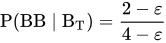
If ε is now set to 1 / 7 , the probability becomes 13 / 27 , or about 0.48. In fact, every bit ε approaches 0, the total probability goes to 1 / two , which is the answer expected when one child is sampled (east.g. the oldest child is a boy) and is thus removed from the pool of possible children. In other words, as more and more than details about the boy child are given (for instance: born on January i), the chance that the other child is a girl approaches i half.
It seems that quite irrelevant information was introduced, yet the probability of the sexual activity of the other child has changed dramatically from what it was before (the chance the other child was a girl was 2 / 3 , when it was not known that the boy was born on Tuesday).
To understand why this is, imagine Marilyn vos Savant's poll of readers had asked which day of the week boys in the family were born. If Marilyn then divided the whole data fix into seven groups - one for each day of the calendar week a son was born - six out of seven families with ii boys would be counted in two groups (the group for the mean solar day of the week of nascency male child ane, and the group of the day of the calendar week of birth for boy 2), doubling, in every grouping, the probability of a boy-boy combination.
However, is it really plausible that the family unit with at least one male child born on a Tuesday was produced by choosing simply ane of such families at random? Information technology is much more easy to imagine the following scenario.
- Nosotros know Mr. Smith has two children. Nosotros knock at his door and a male child comes and answers the door. We inquire the boy on what day of the calendar week he was born.
Presume that which of the 2 children answers the door is adamant past chance. Then the process was (1) pick a two-child family unit at random from all two-child families (2) option ane of the two children at random, (three) encounter if it is a boy and inquire on what mean solar day he was born. The chance the other child is a daughter is 1 / 2 . This is a very different procedure from (1) picking a two-kid family at random from all families with two children, at least 1 a boy, built-in on a Tuesday. The chance the family consists of a boy and a girl is 14 / 27 , near 0.52.
This variant of the boy and girl problem is discussed on many internet blogs and is the subject of a paper past Ruma Falk.[13] The moral of the story is that these probabilities practice non merely depend on the known data, but on how that information was obtained.
Psychological investigation [edit]
From the position of statistical analysis the relevant question is oftentimes ambiguous and as such there is no "correct" answer. Even so, this does not exhaust the boy or girl paradox for it is not necessarily the ambiguity that explains how the intuitive probability is derived. A survey such as vos Savant'due south suggests that the bulk of people prefer an understanding of Gardner's problem that if they were consistent would lead them to the 1 / three probability answer but overwhelmingly people intuitively arrive at the one / 2 probability answer. Ambivalence all the same, this makes the trouble of interest to psychological researchers who seek to understand how humans guess probability.
Fox & Levav (2004) used the problem (chosen the Mr. Smith problem, credited to Gardner, only not worded exactly the aforementioned as Gardner'due south version) to exam theories of how people estimate conditional probabilities.[2] In this study, the paradox was posed to participants in 2 ways:
- "Mr. Smith says: 'I accept two children and at least i of them is a boy.' Given this information, what is the probability that the other child is a boy?"
- "Mr. Smith says: 'I have 2 children and it is not the instance that they are both girls.' Given this information, what is the probability that both children are boys?"
The authors argue that the beginning formulation gives the reader the mistaken impression that at that place are two possible outcomes for the "other child",[2] whereas the second formulation gives the reader the impression that there are four possible outcomes, of which one has been rejected (resulting in one / 3 being the probability of both children beingness boys, as there are three remaining possible outcomes, simply one of which is that both of the children are boys). The study found that 85% of participants answered 1 / two for the first formulation, while but 39% responded that mode to the second formulation. The authors argued that the reason people respond differently to each question (along with other similar bug, such as the Monty Hall Trouble and the Bertrand's box paradox) is because of the utilise of naive heuristics that fail to properly define the number of possible outcomes.[ii]
Run across also [edit]
- Bertrand paradox (probability)
- Necktie paradox
- Sleeping Beauty problem
- Leningrad paradox
- 2 envelopes problem
References [edit]
- ^ a b Martin Gardner (1961). The Second Scientific American Book of Mathematical Puzzles and Diversions. Simon & Schuster. ISBN978-0-226-28253-4.
- ^ a b c d e f 1000 h Craig R. Play a joke on & Jonathan Levav (2004). "Sectionalization–Edit–Count: Naive Extensional Reasoning in Judgment of Provisional Probability" (PDF). Journal of Experimental Psychology. 133 (4): 626–642. doi:10.1037/0096-3445.133.4.626. PMID 15584810. S2CID 391620. Archived from the original (PDF) on 2020-04-10.
- ^ a b c d e Bar-Hillel, Maya; Falk, Ruma (1982). "Some teasers concerning conditional probabilities". Cognition. eleven (ii): 109–122. doi:x.1016/0010-0277(82)90021-X. PMID 7198956. S2CID 44509163.
- ^ a b c Raymond Southward. Nickerson (May 2004). Knowledge and Chance: The Psychology of Probabilistic Reasoning. Psychology Press. ISBN0-8058-4899-ane.
- ^ a b "Inquire Marilyn". Parade Magazine. October 13, 1991 [January 5, 1992; May 26, 1996; December ane, 1996; March 30, 1997; July 27, 1997; October 19, 1997].
- ^ Tierney, John (2008-04-10). "The psychology of getting suckered". The New York Times . Retrieved 24 February 2009.
- ^ a b Leonard Mlodinow (2008). The Drunkard'south Walk: How Randomness Rules our Lives. Pantheon. ISBN978-0-375-42404-five.
- ^ Nikunj C. Oza (1993). "On The Defoliation in Some Pop Probability Problems". CiteSeerX10.1.one.44.2448.
- ^ P.J. Laird; et al. (1999). "Naive Probability: A Mental Model Theory of Extensional Reasoning". Psychological Review. 106 (1): 62–88. doi:10.1037/0033-295x.106.one.62. PMID 10197363.
- ^ a b c d e Matthew A. Carlton and William D. Stansfield (2005). "Making Babies by the Flip of a Coin?". The American Statistician. 59 (2): 180–182. doi:ten.1198/000313005x42813. S2CID 43825948.
- ^ a b Charles Chiliad. Grinstead and J. Laurie Snell. "Grinstead and Snell's Introduction to Probability" (PDF). The Take a chance Project.
- ^ a b Stephen Marks and Gary Smith (Winter 2011). "The Two-Kid Paradox Reborn?" (PDF). Chance (Magazine of the American Statistical Association). 24: 54–9. doi:10.1007/s00144-011-0010-0. Archived from the original (PDF) on 2016-03-04. Retrieved 2015-01-27 .
- ^ Falk Ruma (2011). "When truisms clash: Coping with a counterintuitive problem concerning the notorious two-child family unit". Thinking & Reasoning. 17 (iv): 353–366. doi:10.1080/13546783.2011.613690. S2CID 145428896.
External links [edit]
- At Least I Girl at MathPages
- A Trouble With Two Bear Cubs
- Lewis Carroll'due south Pillow Problem
- When intuition and math probably look incorrect
Source: https://en.wikipedia.org/wiki/Boy_or_Girl_paradox
0 Response to "Probability of 1 Girl and 3 Boys in a Family of 4 Childrens"
Publicar un comentario