List in Order From Oldest First to Newest Last the Development of Technology With Visual Arts
/https://tf-cmsv2-smithsonianmag-media.s3.amazonaws.com/filer/d9/b8/d9b86288-12c0-4d93-95bd-795364577599/pollution_art_final.jpg)
Where would the Impressionists have been without the invention of portable pigment tubes that enabled them to paint outdoors? Who would have heard of Andy Warhol without silkscreen printing? The truth is that technology has been providing artists with new ways to express themselves for a very long time.
Yet, over the past few decades, art and tech have become more intertwined than ever before, whether it'southward through providing new means to mix different types of media, allowing more human interaction or simply making the process of creating it easier.
Case in point is a bear witness titled "Digital Revolution" that opened earlier this summertime in London's Barbican Centre. The exhibit, which runs through mid-September, includes a "Digital Archaeology" section which pays homage to gadgets and games that non that long ago dazzled usa with their innovation. (Yeah, an original version of Pong is in that location, presented as lovable antiquity.) But the bear witness also features a wide diverseness of digital artists who are using engineering to push button art in unlike directions, oftentimes to allow gallery visitors to engage with it in a multi-dimensional fashion.
Here are 7 examples, some from "Digital Revolution," of how technology is reshaping what art is and how it's produced:
Kumbaya meets lasers
Permit's start with lasers, the brush stroke of so much digital art. I of the more pop exhibits in the London show is called "Assemblance," and it'due south designed to encourage visitors to create light structures and floor drawings by moving through colored laser beams and fume. The inclination for most people is to piece of work lone, only the shapes they produce tend to be more fragile. If a person nearby bumps into their construction, for instance, it's likely to autumn apart. But those who collaborate with others—even if information technology's through an act as unproblematic as holding hands—detect that the light structures they create are both more than resilient and more than sophisticated. "Assemblance," says Usman Haque, one of the founders of Umbrellium, the London fine art collective that designed it, has a sand castle quality to information technology—like a rogue moving ridge, i overly ambitious person can wreck everything.
And they never wet the rug
Some other favorite at "Digital Revolution" is an feel called "Petting Zoo." Instead of rubbing cute goats and furry rabbits, you get to cozy upwardly to snake-like tubes hanging from the ceiling. Doesn't sound like fun? But wait, these are very responsive tubes, angle and moving and changing colors based on how they read your movements, sounds and affect. They might pull dorsum shyly if they sense a large group budgeted or go all cuddly if you're being affectionate. And if you're only continuing in that location, they may human activity bored. The immersive artwork, developed past a design group called Minimaforms, is meant to provide a glimpse into the future, when robots or even artificial pets will be able to read our moods and react in kind.
At present this is a work in progress
If Rise Colorspace, an abstract artwork painted on the wall of a Berlin gallery, doesn't seem and so fabulous at first glance, but requite it a little time. Come up back the next day and it will wait at to the lowest degree a little different. That's because the painting is always irresolute, thank you to a wall-climbing robot called a Vertwalker armed with a pigment pen and a software program instructing information technology to follow a certain pattern.
The creation of artists Julian Adenauer and Michael Haas, the Vertwalker—which looks like a flattened iRobot Roomba—is constantly overwriting its own piece of work, cycling through eight colors every bit information technology glides up vertical walls for two to iii hours at a time earlier it needs a battery change. "The procedure of creation is ideally endless," Haas explains.
The dazzler of dirty air
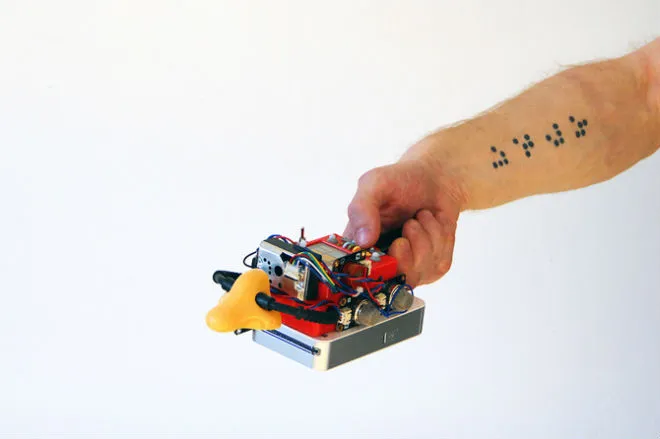
Give Russian artist Dmitry Morozov some credit—he'due south devised a way to make pollution cute, even if his purpose is to brand us aware of how much is out in that location. First, he built a device, complete with a little plastic olfactory organ, that uses sensors which can measure grit and other typical pollutants, including carbon monoxide, formaldehyde and marsh gas. So, he headed out to the streets of Moscow.
The sensors translate the data they get together into volts and a computing platform called Arduino translates those volts into shapes and colors, creating a movie of pollution. Morozov'southward device then grabs still images from the picture show and prints them out. As irony would have it, the dirtier the air, the brighter the image. Frazzle fume tin can look peculiarly vibrant.
Newspaper cuts yous tin can love
Eric Standley, a professor at Virginia Tech, is one artist who doesn't use applied science to brand the creation process simpler. Actually, information technology'due south but the reverse. He builds stained glass windows, just they're fabricated from newspaper precisely cut by a laser. He starts by cartoon an intricate design, then meticulously cuts out the many shapes that, when layered over one another, form a 3-D version of his drawing. One of his windows might comprise as many as 100 laser-cut sheets stacked together. Standley says the engineering science allows him to feel more than, not less, connected to what he's creating. Every bit he explains in the video above, "Every efficiency that I proceeds through technology, the void is immediately filled with the question, 'Can I make information technology more complex?'"
And now, a moving lite show
It's i thing to project laser calorie-free onto a stationary wall or into a dark sky, now pretty much standard fare at public outdoor celebrations. But in an fine art projection titled "Light Echoes," digital media artist Aaron Koblin and interactive manager Ben Tricklebank executed the concept on a much larger calibration. One dark last year, a laser they mounted on a crane atop a moving railroad train projected images, topographical maps and even lines of poetry into the dark Southern California countryside. Those projections left visual "echoes" on the tracks and around the train, which they captured through long-exposure photography.
Finding your inner bird
Here'south one last take from the "Digital Revolution" show. An art installation developed by video artist Chris Milk called "Treachery of the Sanctuary," information technology's meant to explore the creative process through interactions with digital birds. That'southward right, birds, and some are very angry. The installation is a giant triptych, and gallery visitors tin can stand in front of each of the screens. In the get-go, the person's shadow reflected on the screen disintegrates into a flock of birds. That, co-ordinate to Milk, represents the moment of creative inspiration. In the 2d, the shadow is pecked away past virtual birds diving from in a higher place. That symbolizes critical response, he explains. In the 3rd screen, things get amend—yous run across how you'd look with a majestic set of behemothic wings that flap as you movement. And that, says Milk, captures the instant when a artistic idea transforms into something larger than the original idea.
Source: https://www.smithsonianmag.com/arts-culture/7-ways-technology-is-changing-how-art-is-made-180952472/
0 Response to "List in Order From Oldest First to Newest Last the Development of Technology With Visual Arts"
Publicar un comentario