Men Are Gone Out This planet Never Live Again
What would happen to Earth if humans went extinct?
Deep within Guatemala's rainforest sits ane of the most famous remnants of the Maya civilisation: a roughly 2,000-twelvemonth-sometime citadel turned to ruins called Tikal. When Alan Weisman hiked through the surrounding region, he discovered something fascinating along the mode: "You're walking through this really dense rainforest, and y'all're walking over hills," said Weisman, writer and journalist. "And the archaeologists are explaining to you that what y'all're actually walking over are pyramids and cities that haven't been excavated."
In other words, we know about sites like Tikal considering humans have gone to great efforts to dig upwards and restore their remains. Meanwhile, countless other ruins remain hidden, sealed below woods and earth. "It's just amazingly thrilling how fast nature can coffin us," Weisman told Live Science.
This scene from the rainforest allows us a glimpse of what our planet could expect like, if humans simply stopped existing. Lately, that idea has been particularly pertinent, as the global COVID-19 pandemic has kept people inside, and emboldened animals to render to our quieter urban environments — giving us a sense of what life might look like if we retreated further into the background. Weisman, who wrote "The World Without U.s." (Thomas Dunne Books, 2007), spent several years interviewing experts and systematically investigating this question: What would happen to our planet — to our cities, to our industries, to nature — if humans disappeared?
Related: What could drive humans to extinction?
A unlike kind of skyline
In that location are several developing theories for what could drive humanity to extinction, and it is unlikely that nosotros'd all simply disappear in an instant. Nevertheless, imagining our sudden and complete eradication from the planet — perchance by an every bit-yet undiscovered, man-specific virus, Weisman said — is the most powerful manner to explore what could occur if humans left the planet.
In Weisman'due south own inquiry, this question took him firstly into cities, where some of the most dramatic and immediate changes would unfold, thank you to a sudden lack of human maintenance. Without people to run pumps that divert rainfall and ascent groundwater, the subways of huge sprawling cities like London and New York would flood within hours of our disappearance, Weisman learned during his research. "[Engineers] have told me that it would have most 36 hours for the subways to flood completely," he said.
Lacking man oversight, glitches in oil refineries and nuclear plants would become unchecked, likely resulting in massive fires, nuclear explosions and devastating nuclear fallout. "There'southward going to be a gush of radiation if suddenly we disappear. And that's a real wildcard, it'southward almost incommunicable to predict what that'south going to practice," Weisman said. Similarly, in the wake of our demise, nosotros'd leave behind mountains of waste — much of it plastic, which would probable persist for thousands of years, with effects on wild animals that we are only at present start to understand.
Meanwhile, petroleum waste product that spills or seeps into the footing at industrial sites and factories would be broken down and reused by microbes and plants, which would probably accept decades. Persistent organic pollutants (POPs) — man-made chemicals such as PCBs that currently tin can't be broken down in nature — would have much longer, Weisman says. "Some of these POPs may exist around until the stop of time on Earth. In time, however, they will be safely buried away." The combined rapid and tiresome release of all the polluting waste we leave behind would undoubtedly have damaging effects on surrounding habitats and wild animals. (But that doesn't necessarily mean total destruction: We need but look at the rebounding of wild fauna at the site of the Chernobyl nuclear disaster to understand that nature can be resilient on short timescales, even under such extremes.)
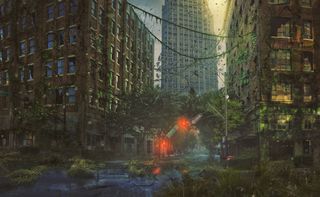
While that polluting legacy unfolds, water running clandestine in cities would corrode the metal structures that agree upward the streets above subterranean send systems, and whole avenues would collapse, transformed all of a sudden into mid-city rivers, Weisman explained. Over successive winters, without humans to do regular de-icing, pavements would cleft, providing new niches for seeds to have root — carried on the air current and excreted by overflying birds — and develop into trees that go on the gradual dismemberment of pavements and roads. The same would happen to bridges, without humans at that place to weed out rogue saplings taking root between the steel rivets: coupled with general deposition, this could dismantle these structures within a few hundred years.
Related: Are copse vegetarian?
With all this fresh new habitat opening upward, nature would stoically march in, pasting over the formerly concrete jungle with grasslands, shrubbery and dense stands of trees. That would cause the accumulation of dry organic cloth, such as leaves and twigs — providing the perfect fodder for fires sparked by lightning, which would go roaring through the maze of buildings and streets, potentially razing whole parts of cities to the ground. "Fires are going to create a lot of charred material that volition fall to the street, which is going to be terrific for nurturing biological life. The streets will convert to fiddling grasslands and forests growing up within 500 years," as Weisman tells it.
Over hundreds of years, every bit buildings are subjected to sustained impairment from erosion and fire, they would degrade, he said. The first to topple would exist modernistic glass and metal structures that would shatter and rust. But tellingly, "buildings that volition concluding the longest are the ones made out of the World itself" — like stone structures, Wesiman added. Even those would go a softened version of their former selves: somewhen the divers, iconic skylines we know then well today would exist no more.
Where the wild things are
Looking beyond the urban center limits to the great swathes of farmland that currently encompass half of Globe's habitable land, there would be a swift recovery of insects, as the application of pesticides and other chemicals ceases with humanity'south demise. "That's going to start a real pour of events," Weisman said. "In one case the insects are doing better, so the plants are going to do much better, then the birds." Surrounding habitats — plant communities, soils, waterways and oceans — will recover, free from the far-reaching influence that chemicals have on ecosystems today. That, in plow, volition encourage more than wild fauna to move in and take upwardly residence.
This transition will precipitate an increment in biodiversity on a global scale. Researchers who have modeled the diversity of megafauna — the likes of lions, elephants, tigers, rhinoceroses and bears — across the planet have revealed that the world used to be uncommonly rich in these species. Only that changed when humans began to spread across the planet, hunting these animals and invading their habitats. Every bit humans migrated out of Africa and Eurasia to other parts of the earth, "we see a consequent increase in extinction rates following the arrival of humans," explained Søren Faurby, a lecturer in macroecology and macroevolution at the University of Gothenburg in Sweden. "In Commonwealth of australia, there is an increase in extinction near threescore,000 years ago. In Due north and Due south America, an increment is seen [nearly] 15,000 years ago, and in Republic of madagascar and the Caribbean islands a drastic increase is seen a few thousand years ago."
Related: Why haven't all primates evolved into humans?
Without humans spreading to the far corners of the World and driving down megafauna populations, the entire planet could have been equally diverse in these species as the famed Serengeti in Eastward Africa is today, Faurby told Live Science. "Effectively, there used to be large animals everywhere, and there would be large animals everywhere around the earth without human involvement." His inquiry has revealed that without humanity'due south heavy species touch on, the primal U.s.a., and parts of S America, would be the nearly megafauna-rich places on Earth today. Animals similar elephants would be a common sight in the Mediterranean Islands. There would fifty-fifty be rhinoceroses across nearly of northern Europe.
Without humans, could Earth reclaim that diversity? Even if we did of a sudden disappear from the film, information technology would still take millions of years for the planet to recover from those by extinctions, Faurby and his colleagues accept calculated. They investigated what it would take to return to a baseline level of species richness and a distribution of big-bodied animals beyond the planet that mirrors what nosotros had before mod humans fanned out beyond the globe. They estimate it would have "somewhere between 3 and up to 7 1000000 or more years to become dorsum to the pre-extinction baseline," explained Jens-Christian Svenning, a professor of macroecology and biogeography at Aarhus University in Denmark, and a colleague of Faurby's who has worked on the same body of research.
Basically, "if there weren't human impacts, the whole world would be one big wilderness," Svenning told Live Science.
Nature finds a way
The planet might eventually get lusher and more diverse — just we tin can't dismiss the furnishings of climatic change, arguably humanity's about enduring touch on the planet. Weisman notes the inherent uncertainty in making useful predictions about what volition unfold. For instance, if there are explosions at industrial plants, or oil or gas wellheads that go on to burn long after we're all gone, huge amounts of heat-trapping carbon dioxide would continue to be discharged into the atmosphere, he explained.
Carbon dioxide doesn't stay suspended in the atmosphere forever: Our oceans play an essential office in absorbing vast amounts of carbon dioxide from the air. But in that location are withal limits to how much of information technology the ocean can accept upward without its ain waters acidifying to unhealthy levels — potentially to the detriment of thousands of marine species. There's as well a cap on how much the sea can physically absorb, meaning information technology isn't just the abysmal carbon sink it's ofttimes thought to be.
Related: What are the ingredients of life?
Every bit it stands, electric current levels of CO2 in our atmosphere will already take thousands of years to be fully removed from the atmosphere. (Based on the inquiry he did for his own book, Weisman plant information technology could accept upwards of 100,000 years.) And if the body of water reaches its cap and more greenhouse gases stay suspended up in the atmosphere, the resulting continuous warming will lead to farther melting of the polar ice caps, and the release of fifty-fifty more greenhouse gases from softening permafrost. This will cycle into an ongoing, climate-altering, feedback loop. All this means that nosotros can confidently presume that climate modify's impacts will last long later on nosotros leave.
But to this, Weisman offered a word of hope. During the Jurassic period, he said, in that location was five times as much carbon dioxide in the atmosphere every bit there is today, which led to a dramatic increase in sea acidity. Evidently, however, at that place must have been marine species that coped with these extremes, and went on to evolve and exist part of the planet we know today. Which is to say that ultimately, despite climate extremes and the immense losses they can incur, "nature always finds a way," Weisman said.
There might 1 day be a earth without humans, only that won't end the residue of the planet from soldiering on.
Moving forward
Is there whatsoever point in united states pondering what our planet will look like, without united states here? Well, on the one manus, we might simply take condolement in the knowledge that, free of people, our planet would ultimately exist fine, as Weisman said. In fact, it would ultimately thrive.
But taking a glimpse at this imagined futurity might likewise prompt us to be more mindful of our actions, in a bid to preserve our own spot on the planet, too. Weisman sees an inherent value to visualizing a globe without u.s., which is why he decided to write his book in the start identify. He explained that when he started out, he was witting that many people avoid environmental stories considering it makes them experience bad near the damage that humans are doing to the planet, and how in turn, that's hastening our own demise. "I found out a way to go rid of the fearfulness factor was just to kill [humans] off first," he said, with humor.
With that lark gone, he found, he could focus people'south attending on the planet, and the existent point he wanted to brand: "I wanted people to come across how beautifully nature could come back, and fifty-fifty heal a lot of the scars that we've placed on this planet. Then to think, is there possibly a way to add ourselves back into this movie of a restored Earth?"
Originally published on Live Science.
Source: https://www.livescience.com/earth-without-people.html
0 Response to "Men Are Gone Out This planet Never Live Again"
Publicar un comentario