What Kind of Acid Bath Is Commercial Beef Given
The Importance of Food pH in Commercial Canning Operations
- Jump To:
- Introduction
- pH and microbial growth
- Canning low-acid foods
- Canning loftier-acrid foods
- Acidified foods and formulated acid foods
- Intermediate foods
- References
Introduction
The pH value of a food is a directly function of the gratis hydrogen ions present in that food. Acids present in foods release these hydrogen ions, which give acid foods their distinct sour flavor. Thus, pH may be divers every bit a measure of complimentary acidity. More precisely, pH is defined as the negative log of the hydrogen ion concentration. Therefore, if a food has a pH value of 3.0, then the concentration of hydrogen ions present in that food is equal to 10-3 (0.001) moles/liter. And if the pH value is vi.0, and so the concentration of hydrogen ions equals 10-6 (0.000001) moles/liter. These examples show that the concentration of hydrogen ions decreases equally the pH value of the nutrient increases. This explains the sometimes confusing fact that a low-pH food is a high-acid food and vice versa.
The range of pH is unremarkably considered to extend from 0 to 14. A pH value of seven.0 is neutral, because pure water has a pH value of exactly seven.0. Values less than 7.0 are considered acidic, while those greater than vii.0 are considered basic or alkaline. Figure 1 beneath shows the approximate pH values of several types of foods. A more than detailed listing is given in Appendix ane. A few foods, such as egg whites, sweet corn, and some baked goods may exist basic. But nearly foods are naturally acidic, with a pH value that is less than seven.0. Yet, the pH value of a particular food may have a dramatic event on the blazon of processing needed to safely preserve it.
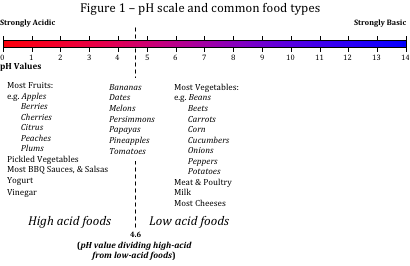
Effigy 1. pH scale and common nutrient types
pH and microbial growth
Microorganisms, including yeasts, molds, and bacteria, are sensitive to a nutrient's pH. Very depression or very high pH values will prevent microbial growth. As a applied thing, no unprocessed food has a pH value high enough to offer much preservative value. Many foods exercise have pH values depression enough to offer some protection against microbial growth. However, very few foods have pH values low plenty to completely inhibit the growth of microorganisms, specially yeasts and molds, which can tolerate lower pH conditions than most leaner. For almost all foods, some combination of microbial controls, such as rut processing, refrigerated or frozen storage, or drying must be used to help preserve the food. Of these, the almost mutual is heat processing or canning. Canned foods may exist defined as any food sold in a hermetically sealed (water and air-tight) container at non-refrigerated temperatures.
Some of the about important pieces of information used in a canning operation are processing times and temperatures. To exist clear, processing times practice not in this instance refer to the time needed to cook the food. Rather, by processing times we mean the heating times needed for canned food products to reach what is known as "commercial sterility." Nosotros may define commercial sterility equally the betoken when any harmful microorganisms capable of growing in the nutrient take been killed. The exact processing time for a canned nutrient product volition depend on several factors. These include the pH of the food, the thickness or viscosity of the production, the size of the food particles, the dimensions of the container, and the temperature of the cooking medium. For canning in particular, the pH of the food plays a key role in determining the extent of estrus processing needed to insure a safe final production.
Canning low-acid foods
Every bit seen in Figure 1, a low-acid food is defined as a nutrient having a pH of more than 4.6 while a loftier-acid nutrient is defined as a nutrient with a pH value of 4.6 or lower. This value is disquisitional because of i detail bacterium, Clostridium botulinum, which produces a dormant class chosen a spore. These spores are extremely hard to kill and may survive for many years, waiting for a chance to grow. An improperly processed tin of food provides an platonic environment for Clostridium botulinum spores, since the bacteria cannot survive in the presence of oxygen. Clostridium botulinum produces an extremely potent neurotoxin that is among the deadliest poisons known. Trace amounts of this toxin, which causes the food-borne illness known as botulism, are plenty to kill. Fortunately, the spores of Clostridium botulinum will non grow if the pH of a nutrient is 4.6 or less. For low-acrid foods with a pH value greater than 4.half-dozen, these spores must exist killed by heating during the canning process. Considering these spores are very estrus resistant, canned low-acid foods must be pressure-cooked at high temperatures for long periods of time. Temperatures of 240°F (115.6°C) or greater are commonly used and process times may range from 20 minutes to several hours. Virtually vegetables, meat, and poultry foods autumn into the depression-acid food category. Because of the necessity of insuring the proper processing of depression-acrid foods, at that place are a number of detailed regulations governing their product. Anyone wishing to can depression-acrid foods must be registered with the FDA, use certified equipment, have received proper training at a "Meliorate Process Control Schoolhouse," and keep extensive records as specified past federal regulations (21CFR Part 113 for FDA-regulated foods and 9 CFR Part 318 for USDA-regulated foods). The canning procedure must also exist reviewed and certified by a Recognized Procedure Authority. A Recognized Process Authority is whatsoever person recognized to accept the training, feel, and equipment needed to determine or verify the sufficiency of a thermal procedure. This person serves as an independent information resource for both the processor and regulatory agencies. Recognized Procedure Authorities may exist affiliated with private companies, universities, or trade organizations.
Canning high-acid foods
Examples of high-acid foods include jams and jellies, pickles, and most fruits. Because there is no fear of Clostridium botulinum growth, these foods require much less heating than low-acid foods. To exist rubber, such foods need simply to achieve pasteurization temperatures. For foods with a pH value of 3.5 or less, 175°F (79.5°C) is a sufficient pasteurization temperature. Those foods with a pH range between iii.5 and 4.0 have a recommended pasteurization temperature of 185°F (85°C). For foods with a pH range of 4.0 to 4.3, the recommended pasteurization temperature rises to 195°F (ninety.five°C). Foods with a pH value betwixt 4.3 and iv.five have a recommended pasteurization temperature of 210°F (99°C). These pasteurization temperatures are sufficient to kill all microorganisms except for bacterial spores. Since the spores will not abound because of the low pH, the food is considered commercially sterile. A high-acid nutrient will therefore not demand the loftier-temperature process that a low-acrid nutrient requires. A high-acrid food may typically be candy in a hot water or steam bathroom at atmospheric pressures – no pressure level-cooking is required. For this type of processing, the sealed container is heated in the bathroom until the internal temperature of the slowest heating point reaches the recommended pasteurization temperature for 2 to ten minutes depending on the pH value and other properties of the food. The time required to achieve this temperature will vary and is usually prepare by a Recognized Process Authority later reviewing the food, evaluating the process, and perhaps conducting heat penetration tests.
It is of import not to over-fill up the containers when a water or stream bath process is used in gild to allow room for product expansion during processing. A headspace of at to the lowest degree ¼ inch (7 mm) is recommended betwixt the lip of the container and the surface of the food or brine. It is too important to make sure the containers are completely covered with water during the process to insure even estrus penetration and avoid nether-processing.
An alternative processing method is to estrus the high-acid nutrient product to pasteurization temperatures and fill information technology hot into jars for sealing. This pop processing technique is known equally "hot-filling" or "hot-fill/concur." Hot-filling works well if done properly. It is important to proceed in heed that the container must be sealed before the food drops below the recommended pasteurization temperature. For this reason, it is a good practise to heat the food to five to 10 degrees higher up the recommended pasteurization temperature before filling. This allows time for filling and sealing. For example, if the recommended pasteurization temperature for the product is 185°F (85°C), then the production should be heated to effectually 195°F (90.ane°C) prior to filling.
Go on in listen that with a hot-make full process the inner surfaces of the jar, jar neck, and cap must also reach pasteurization temperatures in order to kill any microorganisms present on these surfaces. 1 good way to insure this is to turn each container upside downward and hold it for least two minutes after filling and sealing. This allows the hot product to sterilize the inner jar surfaces. After this hold period, the jars may exist cooled if desired.
Note that hot-filling may not work for large particulate products such every bit pickled whole cucumbers or beets in which the pieces are filled into the jar and so covered with hot brine. The mass of the food pieces may crusade the filling brine to cool to beneath safety pasteurization temperatures before the container can be sealed, even if the alkali is boiling hot. For these products, water or steam bath processing may be the merely culling.
Regardless of the method of heat processing employed, if glass jars are used, the glass should exist pre-heated earlier filling/processing in order to temper the glass to avert breakage and to avoid cooling the food excessively during hot-filling. A temperature of 140°F (sixty°C) should be sufficient to achieve this.
The type of spoilage near often encountered in high-acrid foods that take non received a sufficient heat process is caused past yeast or mold. The nigh common sign of mold spoilage is visible mold growth on the pinnacle of the container (mold requires oxygen to grow). Yeast spoilage will cause increasingly cloudy liquid and often container swelling as fermentation causes gas pressure to build up in the sealed container. Both yeast and mold spoilage is hands noticed and will not usually cause serious illness if the food is accidentally eaten. However, cases take occurred in which the growth of yeast or mold has consumed natural acids nowadays in the food and allowed the pH of the food to ascension to the point where Clostridium botulinum grows and botulism toxin is produced. For this reason, yeast and mold spoilage of high-acid canned foods should be viewed as a potentially serious matter. Containers with visible or suspected spoilage – even a light surface layer of mold – should be discarded.
Acidified foods and formulated acid foods
Acidified foods are high-acid foods that incorporate a pregnant percentage of ingredients that are naturally depression-acid. A significant pct is typically deemed to be 10% or more. The pH value of the low-acid ingredients is lowered by the presence of acid in the formula. This acid may be added directly – as in the use of vinegar for pickling – or it may result from the utilise of naturally acid ingredients such as tomatoes. No matter how the acidification is accomplished, all the low-acid components of the nutrient must have up enough acrid to drib their pH values below four.six inside 24 hours.
Some acidified foods are piece of cake to identify. All pickled vegetables clearly fall into this category. Yet, some foods, for example salsas, contain amounts of low-acid ingredients such equally peppers or onions that make them borderline acidified foods. In these cases, review by a Recognized Process Dominance can make up one's mind the regulatory condition of such foods. A food that is deemed to be naturally acrid rather than acidified is termed a "formulated acrid" nutrient.
Acidified foods have a pH iv.half-dozen or lower, therefore they need only be pasteurized to be safety. However, they are regulated more stringently than formulated acid foods simply because any misstep in their production that reduces the ratio of acid to low-acrid ingredients in the formula could result in a food with ingredients that are not sufficiently acidified. Some portions of the food could then have a pH greater than 4.6. If this mistake is not caught, the result can be a deadly case of botulism.
For these reasons, producers of acidified foods must register their formula and processing procedures with the FDA just as do canners of low-acrid foods. The equipment and record keeping regulations (CFR 21 Part 114) are less involved yet. In brusque, there are iv basic requirements for acidified food processors in add-on to the usual requirements for facilities, record keeping, and Adept Manufacturing Practices (GMP's).
- The facility where the nutrient is produced will need to be registered with the FDA. This is accomplished by filing FDA form 2541 with the FDA.
- The processing procedures for each product sold demand to be registered with the FDA. This is washed past filing FDA form 2541a. According to Federal regulations, both class 2541 and 2541a should be filed within 10 days of beginning to produce and sell production.
- Sure production records are required to be kept on hand. Simply stated, the processor needs to keep basic records on conception, processing times and temperatures, pH tests, and container closure evaluation for each batch of product produced. These records demand to exist kept "in an attainable location" for three years from the date of manufacture.
- At least one political party directly responsible for, and present during, the actual production of the acidified food production(due south) needs to receive the proper training past attention a "Better Procedure Control School."
Once again, as with a low-acid food, process times and procedures for acidified foods must be reviewed and approved by a Recognized Procedure Authorization.
Some foods listed in Figure 1, primarily tropical fruits and tomatoes, vary in acerbity and may have a pH that is more than or less than 4.6 depending on the flavour and the variety. When preserving these foods, it is best either to treat these foods as depression-acid foods or else add an acidifying amanuensis such as vinegar or citric acrid to lower the pH well below the critical value of 4.6. These foods would so be treated as acidified foods for regulatory purposes and processed as any other loftier-acrid food.
Table 1. pH Values of Various Vegetables.
| Food | pH | Food | pH | |
|---|---|---|---|---|
| Artichokes (fresh) | 5.6 | Artichokes (canned) | 5.seven - 6 | |
| Asparagus, whole (fresh) | 4-6 | Asparagus, buds (fresh) | 6.seven | |
| Asparagus, stalks (fresh) | 6.1 | Asparagus (canned) | five.2 - 5.3 | |
| Beans | 5.seven - 6.2 | Beans, string (fresh) | 4.6 | |
| Beans, lima (fresh) | 6.v | Beans, kidney (fresh) | v.four - 6 | |
| Beets (fresh) | 4.9 - v.6 | Beets (canned) | 4.9 | |
| Brussel sprouts | 6.0 - vi.3 | Cabbage (fresh) | five.two - vi.0 | |
| Cabbage, greenish (fresh) | 5.4 - half-dozen.nine | Cabbage, white (fresh) | 6.ii | |
| Carrots (fresh) | 4.nine - 5.ii | Carrots (canned) | 5.18 - 5.22 | |
| Carrot juice | vi.4 | Cauliflower | 5.half-dozen | |
| Celery | 5.seven - half-dozen.0 | Chives | 5.2 - half dozen.one | |
| Corn (fresh) | vi.0 - 7.5 | Corn (canned) | 6.0 | |
| Corn, sugariness (fresh) | 7.three | Cucumbers | 5.one - v.seven | |
| Dill pickles | iii.2 - 3.5 | Eggplant | iv.5 - 5.three | |
| Hominy (cooked) | half dozen | Horseradish | 5.35 | |
| Kale (cooked) | 6.4 - 6.8 | Kohlrabi (cooked) | five.7 - v.8 | |
| Leeks | 5.v - vi.0 | Lettuce | 5.8 - 6.0 | |
| Lentils (cooked) | 6.three - half-dozen.8 | Mushrooms (cooked) | six.ii | |
| Okra (cooked) | 5.v - 6.four | Olives, (green) | 3.6 - three.8 | |
| Olives, black | vi.0 - 6.5 | Onions, red | five.iii - 5.8 | |
| Onions, white | 5.4 - 5.8 | Onions, xanthous | v.four - five.half dozen | |
| Parsley | 5.seven - vi.0 | Parsnip | 5.3 | |
| Peas (fresh) | 5.8 - vii.0 | Peas (Frozen) | 6.4 - 6.7 | |
| Peas (canned) | 5.vii - half dozen.0 | Peas (dried) | half-dozen.v - six.8 | |
| Pepper, red or green (fresh) | five.15 | Pimiento | 4.six - 4.nine | |
| Potatoes | 6.1 | Potato tubers | 5.7 | |
| Radishes, red | 5.8 - half dozen.5 | Radishes, white | 5.5 - five.7 | |
| Rhubarb (fresh) | 3.1 - three.iv | Rhubarb (canned) | 3.4 | |
| Rice, dark-brown (cooked) | 6.two - vi.7 | Rice, white (cooked) | 6.0 - half dozen.seven | |
| Rice, wild (cooked) | six.0 - 6.iv | Sauerkraut | 3.4 - 3.half-dozen | |
| Sorrel | 3.7 | Spinach (fresh) | 5.v - 6.8 | |
| Spinach (cooked) | 6.vi - 7.two | Spinach (frozen) | vi.3 - 6.5 | |
| Squash, yellowish (cooked) | 5.8 - 6.0 | Squash, white (cooked) | five.5 - v.7 | |
| Squash, Hubbard (cooked) | 6.0 - 6.2 | Tomatoes, red (fresh) | 4.2 - 4.ix | |
| Tomato paste (canned) | 3.5 - iv.7 | Tomatoes, blood-red, whole (canned) | three.5 - four.7 | |
| Tomato plant juice | 4.1 - iv.2 | Turnips (fresh) | 5.2 - 5.five | |
| Zucchini (cooked) | 5.8 - half dozen.ane |
Tabular array two. pH Values of Various Fruits.
| Food | pH | Nutrient | pH | |
|---|---|---|---|---|
| Apples, Red Succulent (fresh) | 3.9 | Apples, Gilded Delicious (fresh) | three.6 | |
| Apples, Jonathan (fresh) | 3.33 | Apples, McIntosh (fresh) | iii.34 | |
| Apples, Winesap (fresh) | iii.47 | Apple Juice | iii.4 - 4.0 | |
| Apple Sauce | 3.3 - 3.six | Apricots (fresh) | 3.iii - 4.0 | |
| Apricots (dried) | 3.half-dozen - 4.0 | Apricots (canned) | three.75 | |
| Bananas | iv.v - v.2 | Blackberries (fresh) | iii.two - 4.5 | |
| Blueberries (fresh) | iii.7 | Blueberries (frozen) | 3.1 - iii.35 | |
| Cantaloupe | vi.17 - 7.13 | Cherries (fresh) | 3.two - iv.1 | |
| Cranberry sauce | ii.4 | Cranberry juice | 2.3 - two.v | |
| Currants (ruddy) | 2.9 | Dates | vi.3 - half-dozen.half-dozen | |
| Figs | 4.6 | Gooseberries | 2.8 - three.1 | |
| Grapefruit (fresh) | 3 | Grapefruit (canned) | iii.1 - iii.3 | |
| Grapefruit juice | iii | Grapes | iii.iv - 4.5 | |
| Lemons (fresh) | 2.2 - 2.4 | Lemon juice (canned) | 2.3 | |
| Limes | one.8 - two.0 | Mangos | 3.9 - 4.6 | |
| Melon, Cassaba | v.5 - 6.0 | Melon, Honey Dew | vi.3 - half dozen.seven | |
| Melon, Persian | 6.0 - vi.iii | Nectarines | 3.9 | |
| Oranges (fresh) | 3.1 - 4.i | Orange juice | 3.6 - 4.iii | |
| Orange marmalade | three | Papaya | five.ii - 5.7 | |
| Peaches (fresh) | three.4 - 3.6 | Peaches (canned) | 4.2 | |
| Persimmons | 5.four - 5.viii | Pineapple (fresh) | 3.3 - v.2 | |
| Pineapple (canned) | 3.5 | Pineapple juice | 3.5 | |
| Plums (fresh) | 2.eight - 4.6 | Pomegranates | 3.0 | |
| Prunes (fresh) | 3.1 - 5.4 | Prune juice | 3.7 | |
| Clip quince (stewed) | iii.1 - iii.three | Raspberries (fresh) | 3.2 - 3.7 | |
| Strawberries (fresh) | 3.0 - 3.5 | Strawberries (frozen) | two.3 - 3.0 | |
| Tangerines | iv | Watermelon | 5.2 - five.8 |
Table 3. pH Values of Various Meats and Poultry.
| Food | pH | Nutrient | pH | |
|---|---|---|---|---|
| Beef (ground) | 5.1 - half-dozen.ii | Beefiness (aged) | v.viii | |
| Beef (unnamed) | vii.0 | Beef (canned) | 6.6 | |
| Beef Tongue | 5.ix | Ham | v.9 - vi.one | |
| Lamb | 5.four - vi.vii | Pork | 5.3 - 6.9 | |
| Veal | 6 | Chicken | 6.five - 6.7 | |
| Turkey (roasted) | 5.7 - 6.8 |
Table 4. pH Values of Various Fish & Seafood.
| Food | pH | Food | pH | |
|---|---|---|---|---|
| Fish (most fresh) | 6.6 - 6.eight | Clams | 6.five | |
| Crab | 7 | Oysters | 4.8 - vi.3 | |
| Tuna fish | five.2 - 6.1 | Shrimp | six.viii - 7.0 | |
| Salmon | vi.1 - 6.3 | Whitefish | v.5 | |
| Freshwater fish (most) | 6.nine - 7.3 | Sturgeon | five.5 - 6.0 | |
| Herring | 6.1 - half-dozen.4 |
Tabular array five. pH Values of Various Dairy Products
| Food | pH | Food | pH | |
|---|---|---|---|---|
| Butter | 6.one - 6.4 | Buttermilk | 4.v | |
| Milk | 6.2 - 7.three | Acidophilus | 4.0 | |
| Sweet cream | 6.5 |
Table 6. pH Values of Various Cheeses
| Food | pH | Food | pH | |
|---|---|---|---|---|
| Camembert cheese | 7.44 | Cheddar cheese | 5.9 | |
| Cottage cheese | 5 | Cream cheese | iv.88 | |
| Edam cheese | 5.4 | Roquefort cheese | v.five - 5.9 | |
| Swiss Gruyere cheese | five.1 - vi.6 |
Tabular array 7. pH Values of Various Egg Products.
| Food | pH | Food | pH | |
|---|---|---|---|---|
| Egg whites | seven.0 - 9.0 | Egg yolks | 6.4 | |
| Egg solids, whites | half dozen.5 - seven.5 | Egg solids, whole | 7.1 - 7.9 | |
| Eggs, whole, frozen | 8.5 - nine.five |
Table 8. pH Values of Various Baker Products.
| Food | pH | Food | pH | |
|---|---|---|---|---|
| Breadstuff | five.three - five.8 | Eclairs | 4.4 - four.v | |
| Napoleons | 4.4 - 4.5 | Biscuits | 7.1 - 7.3 | |
| Crackers | 7.0 - eight.five | Cake, angel food | 5.2 - 5.6 | |
| Cake, chocolate | 7.2 - 7.6 | Block, devils food | 7.5 - viii.0 | |
| Cake, pound | 6.6 - 7.i | Cake, sponge | vii.4 - 7.vi | |
| Cake, white layer | 7.1 - 7.4 | Cake, yellow layer | 7.3 - vii.6 | |
| Flour, wheat | six.0 - 6.3 |
Tabular array ix. pH Values of Various Miscellaneous Foods.
| Food | pH | Food | pH | |
|---|---|---|---|---|
| Caviar (domestic) | 5.iv | Apple cider | 2.9 - 3.3 | |
| Cocoa powder | half-dozen.iii | Corn syrup | v.0 | |
| Corn starch | 4.0 - 7.0 | Ginger ale | ii.0 - 4.0 | |
| Honey | 3.9 | Jams/Jellies | iii.1 - 3.5 | |
| Mayonnaise | 4.two - 4.5 | Molasses | five.0 - 5.5 | |
| Raisins | 3.eight - iv.0 | Carbohydrate | 5.0 - half-dozen.0 | |
| Vinegar | 2.0 - iii.four | Yeast | iii.0 - iii.5 |
References
Anon. 1962. pH values of food products. Food Eng. 34(three):98-99.
"Acidified Foods" Title 21, Part 114 (21CFR114) in Code of Federal Regulations, Government Press Office, Washington D.C. 1999.
Bridges, 1000.A., and Mattice, Thousand.R. 1939. Over two k estimations of the pH of representative foods. Am. J. Digest. Dis. Nutr. ix:440-449.
FDA Bacteriological Analytical Transmission, sixth Ed. 1984. Chapter 23, Table 11.
William McGlynn
FAPC Horticultural Products Processing Specialist
Was this information helpful?
YESNO
VIEW ALL
Source: https://extension.okstate.edu/fact-sheets/the-importance-of-food-ph-in-commercial-canning-operations.html
0 Response to "What Kind of Acid Bath Is Commercial Beef Given"
Publicar un comentario